For any suggestions or feedback regarding these notes,
please contact Pragy Agarwal
CAP Theorem & PACELC theorem tell us what is possible what is not possible when we talk about distributed systems.
distributed = more than 1 server, connected via some network.
Consistency
When can we talk about consistency?
- Consistency is always about data
- stateless app servers cannot be consistent or inconsistent — because they're stateless - they don't have any data
- At how many Km/hr is your door cooking the color 9?
- answer: undefined
- Ragging question in IITs: What’s the color of an electron?
- answer: undefined
- consistency is typically in context of database or caches
- There have to be multiple copies of the same data (replication/caching)
- if there's only 1 copy of data - then it is guaranteed to be up to date (because reading & writing to the same place)
- the only possible way for things to be out-of-date is when we’ve multiple copies of the same data.
- for example
- database + cache
- or, having database replicas
- There should be a read after an write/update
- if the data is static/immutable, then there's no way of having stale reads - because the data is never updated
- for example, after the contest is over, the leaderboard is always up-to-date (because no new submissions). So after the contest, we won't say that the leaderboard is consistent, we will say that consistency is no longer relevant.
State: some data that we wish to preserve across multiple requests.
So state == data
Stale Reads
When old value of data is read after an update.
Stale reads can (not always) lead to bad user experience
If a stale read is possible, it means that we don't have immediate consistency.
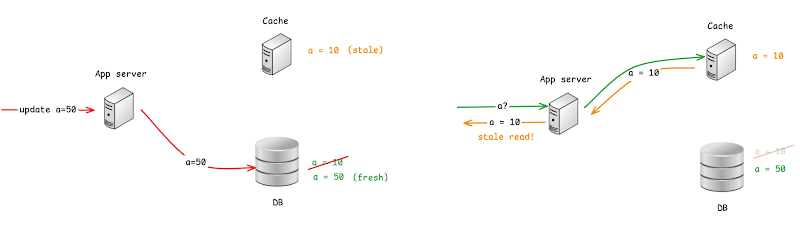
Immediate Consistency (aka. Consistent)
It is impossible for stale reads to happen — every read is guaranteed to read the latest data.
Only possible when all the "copies" are always kept in sync, all the time (or use Quorum)
Immediate consistency is always good to have, but it is very hard to achieve (typically requires 2 phase commit - high latency, low availability)
Because it is hard to achieve, we do NOT always go with immediate consistency.
Eventual Consistency (aka. Not Consistent)
Is it possible for some reads to be stale for some time. But if we wait long enough, then eventually, we will be able to read the updated data.
Note: eventual does NOT mean that eventually the data will be latest (consistent) - it means that every write will eventually reflect in all "copies". It doesn’t mean that data will stop being updated – it means that if you wait long enough, then any update made will be visible in the data.
Eventually the data will be consistent: WRONG — this means that there is a future point in time after which the data will always remain consistent
Eventually every write will reflect in all copies: CORRECT — if we wait long enough, then what we had written earlier, will be reflected. However, the data can still be stale because new writes are coming in continuously.
In 99% of the cases, eventual consistency is good enough.
Data Loss — No Consistency whatsoever
If it is possible for some data to be permanently lost, then it means, that there are some updates that will never reflect in the data.
No matter how long we wait, the data will never become consistent. Data has been permanently lost.
It is very rare for systems to have no consistency (only relevant in case of analytics - when the trend is more important than individual data points)
Q: Are there still more forms of consistency?
Yes.. but all of the other forms fall inside the umbrella of eventual consistency.
Read-your-Write Consistency: If Ashish has edited his post, then he will immediately see the update, but his friends might not see the update immediately (friends will get it eventually).
There’s still more forms..
Availability
Availability refers to whether a server can deny a request or not.
If a server can deny a request - then the system is "not available" or has "low availability".
If a server always satisfies the request - then the system is "available" or has "high availability".
.png)
Q: If a bad request comes to a server, and the server denies the request, is it low availability?
4xx error (bad request) or 3xx error (auth error)
In cases when the user is at fault, the server is allowed to deny the request — it must still respond, but with the appropriate error message.
No this is NOT low availability. We will still call the system as highly available.
Q: If a request comes to a server, but the server crashes (and doesn't respond), is it low availability?
Again, this will NOT be low availability. The request will timeout, the client can just retry, and the LB will send the next request to a healthy server.
Low Availability
If a healthy request comes to a healthy server – but the server still refuses to provide the service (for some internal reason — mostly because it is unable to sync-up with other replicas), then the service is said to have low availability.
Example
- internal server error (bad code / unable to access certain critical resources)
- some specific reason why the server wants to deny service
- request times out (because the server is busy, not because the server is down)
99.999% availability, then in 1 year, you can have a service downtime of maximum 5.26 minutes.
Partition Tolerance
A system is partition tolerant if it can continue functioning seamlessly in the face of network partitions.
When a partition happens, if the system continues working at least partially (some availability might be lost, some consistency might be lost, but the entire system doesn’t go down entirely) the system will be partition tolerant.
If any loss of communication b/w nodes brings down the entire system as a whole — the system is not partition tolerant.
Partition tolerance is very highly desired.
Network Partition
In a network of servers (distributed system), if some subset of the servers is not able to communicate with the other subset of servers, then we have a network partition.
.png)
It is not necessary for the n/w connection to break for the partition to happen.
A slow/congested n/w can behave like a broke n/w because the requests will time out.
Q: How likely is it for a network partition to happen?
In large scale systems distributed (google has 10 million+ servers) network partitions are not just likely, they ALWAYS exist.
Some subset is always disconnected - some node / network will always be down, leading to a small partition somewhere.
100% probability!
There's ALWAYS a partition somewhere.
Availability vs Partition Tolerance
Situation:
- Tarun wants to withdraw money from his bank account via the ATM
- In the backend, the bank will replicate the account information
- because we don’t want to lose the account data if some server/hard-disk crashes
When Tarun withdraw's money from ATM, the bank must update both copies of the data to reflect the new balance.
.png)
Now imagine that a n/w partition happens.
Once there's a n/w partition and the two bank database servers are not able to communicate, the following cases arise
C AP: Highly Available system but low consistent (partition tolerant)
The bank returns success without updating both the servers - it updated the balance in just one server and gives the money to Tarun.
This will give us eventual consistency (stale reads are possible, but once the network is back up, then the db servers can sync up) and it will be highly available.
The data was inconsistent, but the system remained available in the face of n/w partition.
.png)
.png)
A CP: Consistent without Availability (partition tolerant)
The bank database can detect that it is not able to communicate with its replica, and it denies the service.
Low availability, because the request was healthy, the server was healthy, still, the request got denied!
But, we got immediate consistency — stale read was not possible.
However availability suffered — we had to deny the request.
Note: the redeem money functionality is down, but the check balance functionality is still up. So the entire system is not down as a whole — the system is partition tolerant.
.png)
The system has continued functioning even in the face of n/w partitions.
There was low availability for the “money withdrawal”, but the system as a whole didn’t crash!
When will a system be not partition tolerant?
When any n/w partition brings down the entire system!
This is very very rare — most of the backend systems (99.99%) are designed to be partition tolerant.
This happens in the case of stock exchanges (NSE/BSE/SSE/NYSE). Stock Exchanges are A+C systems. They don’t have Partition Tolerance.
If two servers within the stock exchange are unable to communicate with each other, the entire exchange will be shut down until the issue is resolved.
Stock Exchanges therefore do a lot of engineering to minimize the chances of a n/w partition. Each pair of servers will be connected by multiple redundant fiber connections.
In reality, the ATM system, and most banks follow A+P (eventual consistency)
reason: because the banks have found a way to "earn" from their own mistakes.
In reality, if we redeem more money than what you have due to a n/w partition, eventually the n/w partition will resolve and both the bank dbs will be able to communicate. Then they will do automatic "auditing" and they will realize that you redeemed twice.
Tarun's bank balance is now -ve. The bank will charge Tarun an overdraft fee + interest on the 100 Rs he borrowed.
This is also why "refunds" take 5-7 business days, even though payment happens immediately. (note: typically the refund actually happens immediately - but in the worst case, it can take a long time - because eventual consistency)
Theorems
Note: CAP/PACELC will apply only when you have replication (multiple copies of the same data, distributed across multiple servers, which are connected with a network)
CAP theorem
CAP theorem also gives you a fundamental limit of what you can achieve with distributed systems.
.png)
.png)
Google Spanner "seems" to violate the CAP theorem - they claim to provide all 3.
They don't actually violate CAP (they don't claim to violate CAP either)
They do some black magic with timestamps to practically achieve all 3
A+P Systems (high availability + eventual consistency)
Even if there's a partial failure (network partition), the system will still continue functioning (the users' requests will continue being served)
AP systems give up on consistency — they're eventually consistent
99% of all systems are AP. Because mostly, we do not care about immediate consistency
Social Media (twitter / facebook / instagram / ...)
if the user continues to see the old post, or if a new post doesn't appear in your friend's newsfeed immediately, it's not the end of the world — as long as the post gets updated eventually.
C+P Systems (immediate consistency + low availability)
If there's no network partition, only then, the system is able to serve the users.
The moment a network partition happens, the system may deny the users' requests (lose availability)
Rare. Only 0.9% of the systems are C+P
When data is critical
Examples:
- financial transactions & banks
- these are often eventually consistent
- Stock brokers (Zerodha)
- Ticket Booking (Bookmyshow) / Product Purchase (ensure that customers are not ordering more than the inventory amount)
- IRCTC makes ticket booking eventually consistent (they offer you RAC tickets which are resolved later – “eventually”)
CP is rare, because in most of the cases, we’re okay with eventual consistency.
Immediate Consistency is always good to have, but not strictly needed in most systems.
A+C Systems (immediately consistent + highly available + but no partition tolerance)
Never denies the users' request, and always remains consistent as long as there's no network partition.
The moment a network partition happens, the entire system crashes as a whole!
Extremely rare. Only 0.1% cases
Example, stock exchange (NSE, NYSE, SSE, BSE, …)
A+C systems are typically not geographically distributed — because we cannot afford network partitions.
In stock exchanges
- you have very powerful servers
- all the servers are located in the same building
- servers are connected with high speed fiber
- and multiple redundant connections
.png)
The chances of having a network partition in such a system are close to 0 (by design - extremely expensive to maintain)
Still, if a n/w partition happens, then the entire system has to shut down.
CAP theorem (another definition)
1st definition: pick any 2
2nd definition: when there's a n/w partition, you must choose between availability or consistency. You cannot have both.
As long as there’s no n/w partition, you don’t have to worry about anything. The moment a n/w partition happens, you can either choose Consistency, or you can choose Availability. You cannot get both.
Because in large systems
- there's always a n/w partition somewhere
Therefore
- you definitely want partition tolerance
So effectively,
- your choice is typically b/w A+P or C+P
PACELC theorem
PACELC theorem is an extension to the CAP theorem
- When there's a n/w Partition, choose b/w
- Availability (serve potentially stale data), OR
- Consistency (service down, but data remains consistent)
- Else (even when there's no partition), there's trade off b/w
- Latency (low latency because sync up is later), OR
- Consistency (sync up right away, but latency is higher)
Just like in DSA, we have a tradeoff b/w Time Complexity and Space Complexity, we also have a tradeoff in HLD b/w Consistency and Availability, and Consistency and Latency.
Basically
- if you choose immediate consistency, then you have to give up on Availability & Latency both!
- if you want your system to always be consistent, then
- it will be slow (high latency), and
- it might deny requests (low availability)
So immediate consistency comes at a huge cost!
Proof by Story
Aditi's Reminder Service
.png)
Vertical Scaling (Scaling Up): In the start, Aditi was handing this service along with her day job.. but as the number of requests increases, she quit her job and started doing this service full time.
Horizontal Scaling (Scaling Out)
Because Aditi was not able to handle all the calls herself, she hired Sanjana to help her out.
.png)
Q: Should we maintain one shared diary, or two independent diaries?
If we go with a single diary, then
- Aditi & Sanjana will have to be in the same room (colocated geographically - can't be distributed far apart) — it’s not a distributed system
- Both of them will fight for the diary - the diary will become a bottleneck
It is better to have separate diaries
- they can be located far apart (Sanjana can work from home)
- the diary is not the bottleneck.
So we go with the 2 diary approach (because a single diary would render our scaling useless)
Angry Customer
Customer: "Yesterday I called you to remember my flight at 11am in the morning. But then I called you at 8am to ask for my flight timing, and you said that you don't remember. You lost my data, and I missed my flight."
Q: Why did this happen?
When the write request came, it went to Sanjana, but the read request came to Aditi, and Aditi's data was not in sync with Sanjana's data.
Consistency Issue
.png)
Protocol 1 - Sync eventually (at night)
They decide to copy each other's data at each night before they close the shop.
So that in the morning, both have the same copy of data.
.png)
Q: Can there be stale reads still — Can there be angry customer calls?
Yes, until the sync happens (at night) any reads before the sync can potentially be stale.
But if we wait long enough, eventually, the data will be in sync.
So, the data can be stale (low consistency)
but, when a write request comes, we only have to write at 1 place (low latency)
Low Consistency + Low Latency
Protocol 2 - Sync immediately
They decide that whenever one of them gets a call
- write the data in their own diary
- Put the customer on hold
- call the other person
- get the other person to write the data as well in their diary
- only when the other person responds with a success, we can return success
- if the other person returns error, then we should delete from our diary (rollback) and return error
This protocol will give them immediate consistency - the data will always be in sync (because I’m always writing to both diaries)
Note that this will lead to higher latency, as when Aditi is calling Sanajana to copy to write, the client is waiting on the phone.
Also, the throughput will suffer — because now, every call is being multiple twice – it is going both to Aditi and Sanjana. This means that the horizontal scaling that we did is now suffering
Q: Will this protocol also be applied to the reads?
No. This is only for the writes. When a read comes, both Aditi and Sanjana can respond independently using the data in their own diaries (because both of them have all the data)
So no waiting time for Read queries (low latency)
High Consistency + High Latency
.png)
Q: How does Google doc handle this situation?
Gives you eventual consistency (you’re allowed to make changes even when your n/w is down — the changes will sync up eventually, once your n/w is restored)
How? By performing conflict resolution later.
Conflict-Free Replicated Data Types (CRDTs)
CRDTs are very powerful, but also very complex. Google Docs doesn’t actually use CRDTs, but it uses a custom protocol that is a little weaker (but similar) to CRDTs.
Vacation Time
Sanjana decides to go on a vacation.
No availability issue - Sanjana is just on a vacation.
No n/w partition — Sanaja is just on a leave. The calls can be routed to Aditi.
When Sanjana comes back, before she starts taking any calls, she can just sync up with Aditi's diary - no consistency issue here.
.png)
Protocol 1 - Sync eventually (at night)
+ Protocol 2 - Sync immediately
in both the protocols, because Sanaja is simply not present, Aditi can just keep writing in her own diary (even in protocol 2).
When Sanjana comes back, she can sync up before serving any calls.
So no availability issue, no consistency issue. Why? Because there’s no n/w partition. It’s just that some server (Sanjana) is down.
Big Fight
Sanjana & Aditi have a big fight, and they refuse to talk to each other (n/w partition)
.png)
Protocol 1 - Sync eventually (at night)
No worries — both of them can continue taking calls & continue writing in their own diaries.
Eventually, the fight will resolve (n/w will be fixed) — they can just sync up their diaries when they're friends again.
Data will remain stale until the fight resolves. But the service will continue to be available.
Partition ⇒ High Availability + Eventual Consistency
Protocol 2 - Sync immediately
The protocol mandates that Aditi must write to both the places, but she's not talking to Sanjana
So when she gets a "write" call, she must deny.
Note that she can still continue serving "read" requests from her own diary! But any write requests must be denied until the fight resolves.
.png)
Partition ⇒ Immediate Consistency + Low Availability
Note that only the write requests are unavailable – the read requests continue. But overall, we will say that the system has low availability.
Replication
Explicitly (by choice) having multiple copies of the same data. These copies will be stored in different servers.
Isn't replication bad?
RDBMS - we study normalization.
While studying normalization, we say that redundancy (duplicate data) is bad, because it leads to various anomalies (read / write / delete / ...)
Course | Student |
HLD | Tarun |
HLD | Sanjana |
LLD | Harini |
DBMS | Sanjana |
If we update the name from HLD ⇒ High Level Design
But, we fail to update all places (inconsistency)
Effectively, we’ve an additional course now!
Course | Student |
High Level Design | Tarun |
HLD | Sanjana |
LLD | Harini |
DBMS | Sanjana |
If we delete Sanjana
we have mistakenly deleted the course DBMS (because Sanjana was the only entry with DBMS)
Course | Student |
HLD | Tarun |
HLD | Sanjana |
LLD | Harini |
DBMS | Sanjana |
Normalized design (which gets rid of these anomalies)
Course ID | Course Name |
1 | HLD |
2 | LLD |
3 | DBMS |
Student ID | Student Name |
1 | Sanjana |
2 | Tarun |
3 | Harini |
Student ID | Course ID |
1 | 1 |
1 | 3 |
2 | 1 |
3 | 2 |
Why do we need replication?
Replication is the ONLY way that we can protect ourselves from data loss.
"D" in ACID stands for durability - any committed transaction will be persisted on the disk. So if there's a power failure, once the system restarts, we will find that transaction in the database, it will not be lost.
ACID Durability is about persistent vs volatile memory. It does NOT protect you from HDD failures.
“ The only way to prevent data loss in case of HDD failures is replication (have multiple copies of the same data across multiple disks). ”
Replication vs Sharding
There's no point in replicating the data within the same server (useless redundancy) — we’re just wasting disk space, and if the server crashes, we still lose data.
You always replicate across multiple servers (useful redundancy)
Replication | Sharding | |
Having multiple copies of the same data across multiple servers | Partition data horizontally across servers | |
Replication == Copying | Sharding == Splitting | |
Different servers (replicas) have the same data | Different servers (shards) have different data | |
Pros | ||
(gives you resilience)
|
| |
Cons | ||
|
|
.png)
Q: Which one should we use?
Both! Together.
You have more data than a single server can handle, and you also don’t want to lose the data.
Large systems have both sharding & replication at the same time.
Q: What about Caching?
Caching is kind-of like replication.
In caching, your data is in 2 places
- database, and
- cache
It's not pure replication — caching will not save you from data loss - because caches are volatile (they store data in RAM typically).
Cache
- doesn't save you from data loss (because cache is volatile)
- improves read throughput (good)
- worsens write latency & throughput (bad)